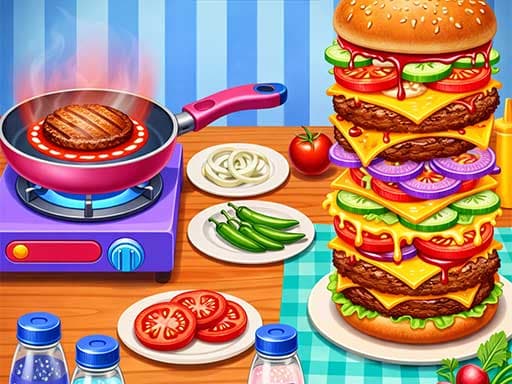
I went into Fast Food Cooking expecting a fairly standard cooking experience and came out having spent far more time with it than I had any right to. That sentence could describe a lot of the games I write about, but it's particularly true of this one. Fast Food Cooking does something that a lot of games in this space fail to do: it commits fully to its concept, executes that concept with care, and trusts the player to engage with it on its own terms. The result is a game that feels distinctive even within an increasingly crowded field of browser-based releases.
The premise, as far as premises go, is straightforward. Welcome to Fast Food Cooking - the most complete, most engaging, and most satisfyingly deep restaurant management game ever to grace the casual gaming genre, a game that begins with the humble dream of a small food stall and challenges you to transform that dream through skill, strategy, and relentless self-improvement into a thriving, multi-location restaurant empire that serves thousands of satisfied customers every single day! You start your culinary journey with the most modest of beginnings: a tiny street food stall with basic equipment, a limited menu, and the burning ambition to prove that great food served fast can conquer even the most crowded market. Your first customers arrive with simple requests - a basic burger, a quick sandwich, a soft drink - and the satisfaction of serving them quickly and correctly provides a taste of the reward that awaits consistent, skillful management. But the game reveals its true depth rapidly: as your reputation grows and word spreads about your quality and service speed, more customers arrive, their orders become more complex and varied, and the challenge of managing multiple simultaneous orders without letting anyone wait too long becomes genuinely demanding. That's the elevator pitch, and it's accurate, but it undersells how the game feels in actual play. Fast Food Cooking has a way of sneaking up on you with small details and thoughtful design choices that add up to something more substantial than the description suggests. The first few minutes of my session felt like I was playing a perfectly fine, perfectly forgettable casual game. By the time I looked up from my screen, an hour had passed and I had been thinking tactically about decisions I didn't even realize I was making.
The core gameplay loop is where Fast Food Cooking earns its reputation. The driving feels right. Whether you're racing against the clock, against other vehicles, or just exploring the open world, the vehicle handling is calibrated to feel responsive without being arcadey to the point of feeling weightless. There's a real sense of momentum and physicality that makes every turn, every drift, every collision feel consequential. The building and management mechanics are where the game reveals its depth. There's a real satisfaction in taking a system apart, understanding how the pieces fit together, and then putting them back in a more efficient configuration. Whatever your tolerance for casual games, the moment-to-moment experience here is satisfying enough to keep you engaged even during sessions that go longer than you originally planned.
Progression And Replay Value
One of the things that kept me coming back to Fast Food Cooking was the progression system. There's a steady stream of unlockables that gives you a constant sense of forward motion - new weapons, new vehicles, new characters, new abilities, depending on what the game is about. The upgrade system is satisfying without being grindy, and you can see clear, meaningful improvements from each investment, which makes the time you spend feel worthwhile. Replay value is one of the most important qualities in a casual game, and Fast Food Cooking handles it well. The base content is engaging enough to justify your initial time investment, and the meta-game gives you reasons to keep coming back.
Visuals And Audio
The presentation is strong. The art direction has a clear sense of identity, the character designs are memorable, the environments are varied and interesting, and the overall polish is higher than you might expect for a browser release. The audio is similarly well-done - the music sets the right tone, the sound effects are punchy and satisfying, and the overall mix doesn't fatigue the ears even during extended play sessions. The little details, from the way a button click animates to the way a successful action is celebrated with a brief visual flourish, add up to an experience that feels considered rather than thrown together.
What Works, What Doesn't
After extended time with Fast Food Cooking, here's my honest assessment. The strengths are clear: the game has a strong core concept that it executes well, the difficulty is well-tuned, the progression is satisfying, and the overall polish is higher than you might expect. There are a few small weaknesses worth mentioning. The UI can be a little cluttered in places, the early game does take a few minutes to find its rhythm, and some of the later content can feel a touch repetitive if you're playing marathon sessions. None of these are deal-breakers - they're observations about a game that gets the important things right.
Final Verdict
So is Fast Food Cooking worth your time? If you have even a passing interest in cooking games, yes. The game is well-made, the mechanics are satisfying, and the experience is more substantial than its casual presentation suggests. It's not going to change your life, but it's the kind of game that makes you glad you tried it. I went in with modest expectations and came out a fan, which is about the highest compliment I can give a game in this genre.
If you've played Fast Food Cooking, I'd love to hear what you think. If you haven't, this might be the nudge you needed to give it a try.
Gallery